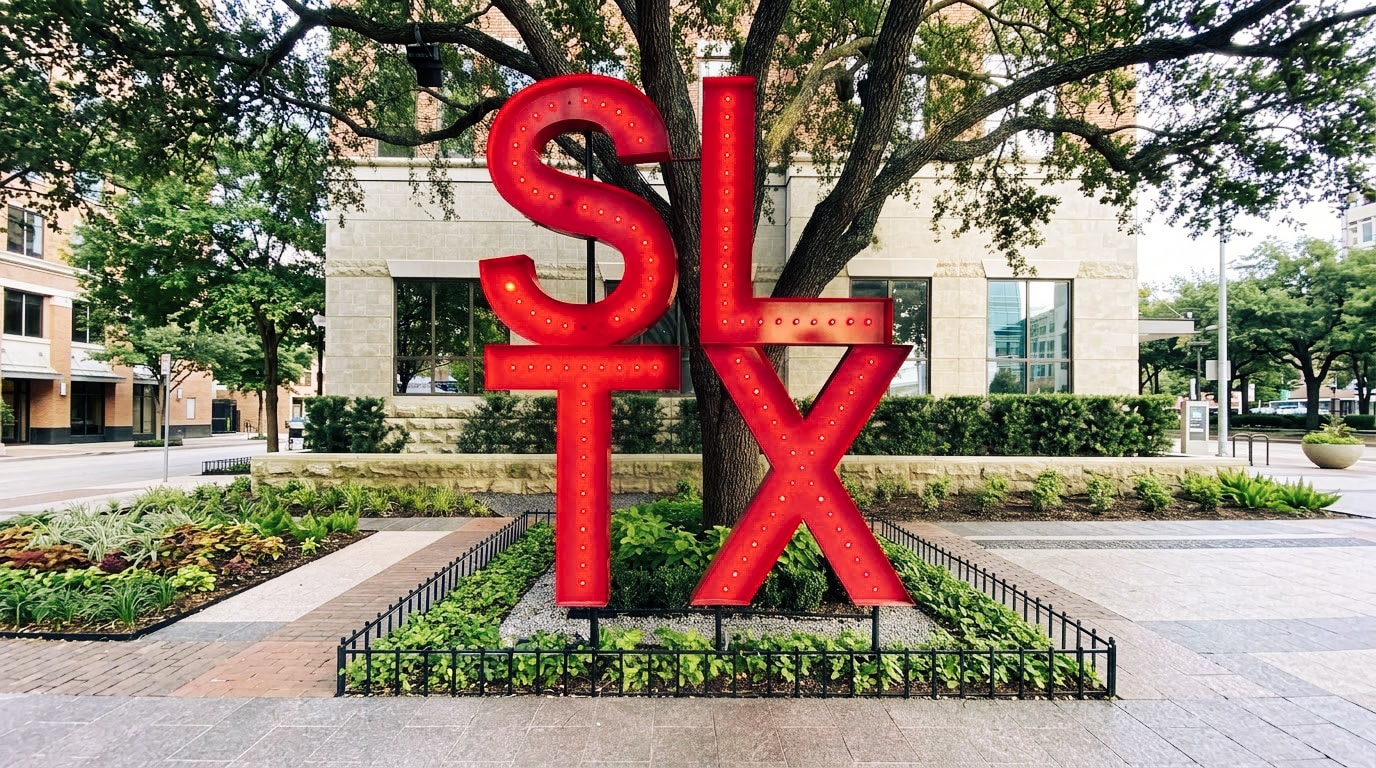
Sugar Land, Texas — The Complete Community Guide for Relocating Families
Sugar Land, Texas — The Complete Community Guide for Relocating Families By Crystal Plummer Spruill | TheHoustonReloGuide.com Last Updated: August 2026
The Quick Version
Sugar Land is a well-established city of roughly 107,000 residents in Fort Bend County, about 20 miles southwest of Houston. It’s one of the highest-income suburbs in the Houston metro, built almost entirely around master-planned communities and anchored by Fort Bend ISD schools. It’s also a city with a real, documented history that goes well beyond its name — including a chapter most relocation guides don’t mention at all.
This guide covers the neighborhoods, the numbers, and what’s actually true, good and bad.
What Is Sugar Land?
Sugar Land takes its name directly from its origin: a sugar refinery built on the site in 1843, which grew into the Imperial Sugar Company — still headquartered here today, with its logo featured on the city’s own seal. The town incorporated in 1959, a year after Imperial Sugar and its related land company began selling off company-owned homes and land to outside developers, opening the door to the master-planned suburb it’s known as today.
Before that development, the area had a much harder reputation — 19th-century accounts referred to the swampy, prison-labor-heavy region as the “Hell Hole of the Brazos.” That history is directly connected to a discovery that made international news: in 2018, construction crews building a Fort Bend ISD career center unearthed an unmarked burial ground containing the remains of 95 Black men and women who had been forced into labor under Texas’s post-Civil War convict leasing system between roughly 1878 and 1909. Known as the Sugar Land 95, the site — now officially designated the Bullhead Convict Labor Camp Cemetery — received a Texas Historical Commission marker in June 2025, and a memorial exhibit is housed at the James Reese Career & Technical Center where the remains were found.
That history sits alongside the more familiar story: post-1959, Sugar Land grew rapidly into one of the most affluent, planned communities in Texas, reaching over 107,000 residents today with a median household income above $130,000 — well above the Texas and national averages.
Geographic Coverage
Sugar Land sits entirely within Fort Bend County, roughly 20 miles southwest of downtown Houston, primarily accessible via US-59/I-69. It borders Missouri City, Stafford, and Richmond, and — like every suburb in this guide series — a “Sugar Land” mailing address doesn’t automatically guarantee a specific school district or tax jurisdiction. Always verify the exact address rather than assuming based on the city name.
The Neighborhoods
Sugar Land is built almost entirely around master-planned communities, most governed by their own HOA — reportedly over 100 registered HOAs citywide, so expect HOA fees and rules to be a real factor almost anywhere you look.
First Colony One of the most established communities in Sugar Land, dating to the 1980s–90s, and generally considered the community that set the standard for master-planned living in this part of Texas. Homes here are older than in the newer western developments, but the trade-off is mature trees, walkable parks, and proximity to Houston. (Verify: some sources describe First Colony as primarily Fort Bend ISD — confirm current zoning for any specific address.)
Greatwood Anchored by its own golf club, generally considered a quieter, more established residential community.
New Territory A large master-planned community on Sugar Land’s western side, with a median household income in the $90,000s and a notably young population — roughly 35% of residents are under 18, suggesting a strong concentration of families with school-age kids.
Riverstone, Telfair, and Sweetwater Riverstone is one of Sugar Land’s larger, more amenity-heavy master-planned communities, with its own network of parks, trails, and lakes. Telfair and Sweetwater round out this newer generation of master-planned development — “newer” here generally meaning 2000s–2010s rather than currently under construction.
Sugar Creek An established, golf-course-anchored community, among the older master-planned neighborhoods in the city.
Riverpark Shares First Colony’s general geography, anchored by a neighborhood H-E-B, with a mix of starter townhomes and larger single-family homes — a solid option for buyers who want Sugar Land’s schools without paying for the newest construction or most elaborate amenities.
Imperial The redeveloped site of the historic Imperial Sugar refinery itself — the same refinery that gave the city its name in the first place — now a mixed-use district with lofts, restaurants, and event space built around the preserved historic refinery buildings. Less a traditional residential neighborhood, more Sugar Land’s answer to a walkable town center.
Venetian Estates and Alkire Lake Sugar Land’s ultra-luxury tier, both built around private lake access, with home prices commonly running into the millions.
Cost of Living
Sugar Land runs meaningfully above both the Texas and national cost-of-living averages, driven primarily by housing. Median home prices have run in the $456,000–$509,000 range through 2026 depending on the specific dataset and month, with actual sale prices spanning from the mid-$200,000s up to $2 million or more depending on the neighborhood. The market has softened slightly from its 2023–2024 peak, giving buyers somewhat more negotiating room than in recent years.
Fort Bend ISD’s 2025 tax rate sits at $1.0569 per $100 of assessed value — a temporary increase implemented under a state law provision. As with every suburb in this series, the combined rate (city, county, school district, and any applicable MUD) varies by exact address, so verify the specific parcel before budgeting.
Texas’s lack of a state income tax offsets some of this cost, and Sugar Land’s household incomes — a median above $130,000 — run well above what’s needed to offset the higher property tax burden for most buyers in this market.
Commute
Sugar Land’s primary commute corridor is US-59/I-69, running northeast into central Houston, the Texas Medical Center, and downtown — commonly cited around 30–40 minutes depending on traffic and exact starting point, noticeably shorter than commutes from communities further out like Fulshear. Highway 6 and Highway 90 (Alt) provide additional direct routes into the city and connect Sugar Land to neighboring Missouri City, Stafford, and Richmond. The Fort Bend Parkway and Sugar Land Regional Airport (a general aviation/executive airport, not commercial) round out the area’s transportation infrastructure.
Schools
Sugar Land is served primarily by Fort Bend ISD, with high schools including Dulles, Kempner, Clements, and Austin (Stephen F. Austin). Fort Bend ISD received a B rating from TEA in the 2024–25 accountability cycle, and Superintendent Roosevelt Nivens was named the Texas Association of School Boards’ 2025 Superintendent of the Year. The district has also faced real budget pressure recently — see the Growth section above for the district’s 2026 school closures, a significant and ongoing story for Sugar Land families to be aware of. We don’t yet have a dedicated Fort Bend ISD guide on this site — that’s on our list to build next, matching the depth of our Katy, Pearland, and Clear Creek ISD guides. Until then, verify specific campus zoning directly with Fort Bend ISD before making a decision based on schools.
Beyond K-12, the University of Houston’s Sugar Land campus gives the city a genuine higher-education presence of its own — the campus added a new 75,000-square-foot academic building in fall 2025, a sign of continued investment rather than a shrinking satellite location.
Lifestyle & Amenities
Sugar Land Town Square anchors much of the city’s dining, shopping, and civic life — a genuine downtown built from scratch starting in 2003, home to City Hall itself along with corporate tenants like Minute Maid’s headquarters and a Coca-Cola office. It regularly hosts concerts and community events for residents, and functions as the closest thing Sugar Land has to a true town center.
Constellation Field hosts the Sugar Land Space Cowboys, the Triple-A minor league affiliate of the Houston Astros — a genuine draw for families, not just a nice-to-have. The Smart Financial Centre, a 6,400-seat performance venue, brings in concerts and larger touring shows that most Houston suburbs simply don’t have access to locally.
Families have real options beyond sports and shows: the Houston Museum of Natural Science at Sugar Land (with its own saltwater aquarium), the Fort Bend Children’s Discovery Center, and First Colony Mall alongside Town Square for everyday shopping. Outdoor space includes the Justin P. Brindley Trail and numerous neighborhood parks tied to the master-planned communities themselves.
Sugar Land is also home to a genuinely international community, reflected in its restaurant variety, grocery options, and the cultural events regularly hosted at Town Square throughout the year — part of what residents consistently point to as one of the city’s strengths.
Faith communities are a real part of Sugar Land’s social fabric — Sugar Creek Baptist Church and Riverstone Church are both long-established congregations with deep community roots here, among many others across the city’s various neighborhoods.
Healthcare
Sugar Land has real hospital infrastructure of its own rather than relying entirely on a drive into Houston. Houston Methodist Sugar Land Hospital (on the Southwest Freeway near Highway 6) holds Magnet Recognition from the American Nurses Credentialing Center — a meaningful quality marker, not just a name — and has been separately recognized among Texas’s best hospitals by U.S. News & World Report. Memorial Hermann Sugar Land Hospital, on West Grand Parkway South (Highway 99), is the city’s other major full-service hospital. OakBend Medical Center, the only independent nonprofit hospital system in Fort Bend County, also operates multiple locations serving Sugar Land, including a hospital campus on Southwest Freeway and outpatient facilities elsewhere in the city — a genuine alternative to the larger corporate hospital systems for families who want that option.
Growth
Sugar Land’s population has actually declined slightly in recent years — down about 3% since the 2020 census, reflecting a largely built-out city rather than one still expanding outward like Katy or Fulshear. Growth here looks more like redevelopment (the Imperial district, built directly on the old Imperial Sugar refinery site) than new subdivisions breaking ground.
That decline has real consequences: enrollment across Fort Bend ISD peaked in the 2023-24 school year at over 80,000 students and has fallen since, driving a projected $56 million budget deficit. In March 2026, the district’s board voted to close seven Sugar Land-area elementary schools — Austin Parkway, Dulles, Arizona Fleming, Glover, Mission West, Ridgegate, and Sugar Mill — with attendance boundary changes affecting roughly 1,500 students rolling out for the 2026-27 school year. Notably, Sugar Mill Elementary carried an A rating from TEA at the time of its closure, a reminder that campus closures here are driven by enrollment and budget math, not necessarily school quality.
On the employer side, Fluor Corporation — a Fortune 500 engineering and construction firm headquartered in Sugar Land for nearly 40 years — relocated its roughly 1,600 Houston-area employees to the Energy Corridor in 2024, part of a broader corporate real estate downsizing rather than anything specific to Sugar Land. The University of Houston’s Sugar Land campus, by contrast, has been expanding — a new 75,000-square-foot academic building opened in fall 2025. Remaining major employers with a real presence in the area include Schlumberger (SLB), Texas Instruments, and Imperial Sugar’s own continued corporate headquarters.
What Relocating Families Need to Know
- Sugar Land is genuinely built out, not still expanding. If new construction specifically matters to you, this likely isn’t the right suburb — that inventory lives further west, in places like Fulshear.
- Nearly every neighborhood has an HOA, and fees and rules vary significantly — factor this into your budget and lifestyle expectations before falling in love with a specific community.
- Fort Bend ISD is actively closing and rezoning campuses due to declining enrollment, including seven Sugar Land-area elementary schools as of 2026. This isn’t a reflection of school quality — one of the closed campuses was A-rated — but it does mean boundary stability is genuinely lower here right now than in a growing district. Verify current zoning directly with the district, not just a listing.
- The city’s history includes the Sugar Land 95 — a documented, memorialized piece of Texas history connected to the post-Civil War convict leasing system. It’s part of the area’s real story, and there’s now a public historical marker and exhibit if you want to learn more directly.
- Income levels here run well above the Houston metro average, which shows up directly in home prices — budget accordingly rather than assuming Sugar Land will be comparably priced to other Fort Bend suburbs.
Is Sugar Land Right for You?
That depends on what you’re optimizing for. Sugar Land offers established neighborhoods, strong schools, a shorter commute into central Houston than many western suburbs, and genuine city-level amenities most suburbs don’t have. It does not offer significant new-construction inventory or the lowest entry price points in Fort Bend County. This guide is a starting point for your own research, not a recommendation of one community over another.
Resources
- Fort Bend ISD: fortbendisd.com
- Fort Bend County Appraisal District: fbcad.org
- City of Sugar Land: sugarlandtx.gov
Ready to Find Your Sugar Land Address?
Understanding the city is the first step. Confirming that a specific home fits your commute, your budget, and your school priorities is the next one.
Or use the Houston Neighborhood Navigator to get your top three suburb matches based on your employer corridor, your family’s priorities, and what the market actually looks like right now.
[Find Your Suburb →]
This guide is provided for informational purposes only and reflects publicly available data as of August 2026, compiled primarily through research rather than firsthand local experience. Home prices, tax rates, and school zoning change regularly and vary by exact address. Always verify current information directly with Fort Bend ISD, the Fort Bend County Appraisal District, and the City of Sugar Land before making any real estate decision. Crystal Plummer Spruill is a licensed Texas REALTOR® brokered by Real Broker LLC (TREC #0688471). Nothing in this guide constitutes a recommendation of one community over another.
Sources: Texas State Historical Association (TSHA), Sugar Land Heritage Foundation, U.S. Census Bureau, World Population Review, Fort Bend ISD, Houston Methodist, Memorial Hermann, Monument Lab, KHOU, Clemson University Woodland Cemetery project, various current Houston-area real estate market reports (2026).
FAQ
Why is it called Sugar Land? The city takes its name from a sugar refinery built on the site in 1843, which grew into the Imperial Sugar Company — still headquartered in Sugar Land today.
Is Sugar Land a good place to raise a family? It’s a well-established, high-income suburb built around master-planned communities and served primarily by Fort Bend ISD. Whether it’s “right” depends on your specific priorities around budget, commute, and school zoning for a given address.
What is the Sugar Land 95? A documented burial ground discovered in 2018 during construction of a Fort Bend ISD career center, containing the remains of 95 Black men and women who were forced into labor under Texas’s post-Civil War convict leasing system in the late 1800s. The site received an official Texas Historical Commission marker in 2025 and includes a memorial exhibit.
Is there new construction available in Sugar Land? Limited — Sugar Land is largely built out, and its population has actually declined slightly in recent years. Buyers specifically seeking new construction typically look further west, toward Fulshear.
How much does a home cost in Sugar Land? Median prices have run roughly $456,000–$509,000 through 2026 depending on the dataset, with actual sale prices ranging from the mid-$200,000s to $2 million or more depending on the neighborhood.
Does Sugar Land have its own hospitals? Yes — Houston Methodist Sugar Land Hospital (Magnet-recognized), Memorial Hermann Sugar Land Hospital, and OakBend Medical Center, the only independent nonprofit hospital system in Fort Bend County, all operate locations in the city.
Is Fort Bend ISD closing schools in Sugar Land? Yes. Facing declining enrollment and a projected $56 million budget deficit, the district’s board voted in March 2026 to close seven Sugar Land-area elementary schools, effective for the 2026-27 school year, alongside broader attendance boundary changes. This reflects district-wide enrollment trends, not the quality of any individual campus.